September Awareness Days for HR: Workplace Wellness & Employee Engagement Ideas [2026]
(Without Making More Work For You)
Key Takeaways
- September is about care, prevention, and steady support, not overwhelming teams as everyone settles back into routine.
- The most effective September programming focuses on mental health awareness, sustainable self-care, and supportive culture-building, not filling the calendar.
- Aim for 2–3 intentional, meaningful touchpoints across the month.
- Key moments include Self-Care Awareness Month, Suicide Prevention Month, Healthy Aging Month, Pain Awareness Month, Labor Day (Sept 7), World Suicide Prevention Day (Sept 10), International Day of Peace (Sept 21), and National Day for Truth and Reconciliation (Sept 30, Canada).
Who This September HR Calendar Is For
This September workplace wellness guide is designed for:
- HR Leaders
- People & Culture Teams
- Office & Workplace Experience Managers
- Executive Assistants
- Wellness Committees
- DEI and ERG Committees
If you’re responsible for planning September awareness days, employee engagement, or wellness programming, this guide is here to save you time, energy, and second-guessing.
If you’re building a larger engagement strategy for the year, our 2026 Workplace Wellness Calendar can help with additional planning ideas.
Download The Full 2026 Calendar (PDF)
All the important days. None of the “wear a silly hat” days. Plan the whole year in 30 minutes.
Download
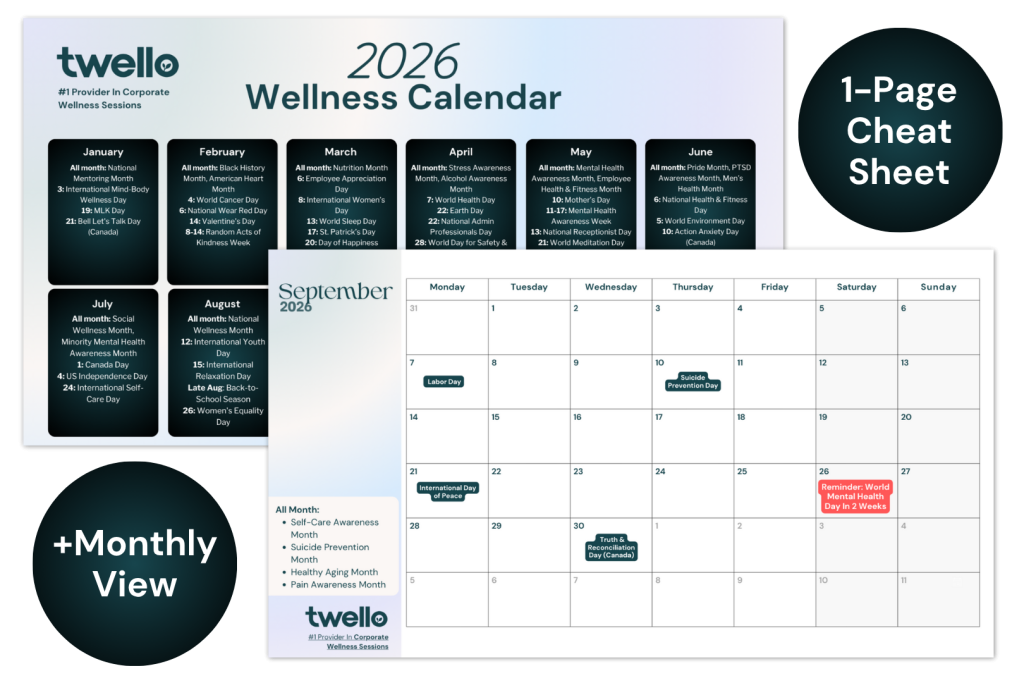
2026 Workplace Awareness Days Calendar (At-A-Glance)
September 2026
| Most Commonly Celebrated ✨ | Just-for-Fun Moments 🎉 | Cultural & Religious Observances 🌍 | Additional Observances 🔎 |
|---|---|---|---|
|
The big moments we see HR teams plan for most often.
|
Optional morale-boosters that are easy to sprinkle in.
|
Meaningful and team-specific. Handle with care.
|
Additional observances that may be relevant for specific communities.
|
How HR Teams Should Plan September Workplace Wellness Programs
Primary focus: Care, prevention, and emotional well-being
Best weeks to activate: Weeks 2–3 (once routines settle post-summer)
Ideal number of initiatives: 2–3 total
September is best treated as a supportive re-entry month.
Teams are returning to regular routines after summer while preparing for a busy Q4. The goal is to help employees feel grounded, supported, and connected — not overwhelmed with new programs or expectations.
Programming that emphasizes care, flexibility, and psychological safety consistently lands better than anything productivity-focused.
Best September Workplace Wellness Themes for Employee Engagement
The most effective September programming is supportive, practical, and easy to engage with. Instead of broad campaigns, anchor your planning around three outcomes:
- Self-care and resilience: Use Self-Care Awareness Month as an opportunity to reinforce sustainable habits and healthy boundaries.
- Mental health visibility: Tie into Suicide Prevention Month and World Suicide Prevention Day with supportive, stigma-free resources and conversations.
- Connection and compassion: Use International Day of Peace and National Day for Truth and Reconciliation as opportunities to encourage empathy, reflection, and respectful dialogue.
If an initiative doesn’t help employees feel more supported, connected, or cared for, it probably doesn’t need to be on the September calendar.
How People & Culture Teams Use September to Support Employee Wellbeing
Strong People & Culture teams use September to reinforce trust and support, not push performance. In practice, that looks like:
- Scheduling one mental health or resilience-focused session during Suicide Prevention Month.
- Offering one self-care, mindfulness, or stress-management workshop as teams settle back into routine.
- Creating space for reflection, learning, or conversation around peace, inclusion, and reconciliation.
When September feels grounded and compassionate, teams enter Q4 more resilient, engaged, and connected.
Common Mistakes to Avoid in September Workplace Wellness Programs
- Over-scheduling heavy mental health content: Supportive programming should feel accessible, not overwhelming.
- Mandatory participation in sensitive topics: Employees should always have choice and flexibility.
- One-size-fits-all wellness challenges: Different people need different forms of support.
- Messaging that feels clinical or impersonal: Human, compassionate communication builds trust.
As always, September wellness should feel supportive, flexible, and stigma-free.

Lets Chat Wellness For Your Team.
- Wellness Classes Your Team Will Actually Enjoy
- Serving Global Teams - Onsite, Virtual & Hybrid
- We Handle Everything - Seamless Planning

How To Celebrate September’s Biggest Observances
🌿 How to Celebrate Self-Care Awareness Month at Work (September 2026)
Quick take: Self-Care Awareness Month should focus on realistic support, not idealized routines. For workplaces, the strongest approach is to make recovery easier to access during the workday.
What to anchor on
- Make self-care operational: Focus on breaks, boundaries, workload clarity, and meeting norms — not just personal habits.
- Keep it accessible: Offer options that work for caregivers, remote employees, frontline teams, and people with limited schedule control.
- Model from the top: Self-care lands better when leaders visibly protect time and avoid glorifying overwork.
Low-lift ideas
- Anchor (30 minutes): Host a Self-Care for Stress Reduction or Daily De-Stress: How To Leave Work At Work session.
- Culture signal: Encourage one no-meeting block or “protected focus” window each week.
- Manager prompt: Ask managers to name one workload or communication norm their team can simplify this month.
What to avoid
- Putting self-care entirely on employees while ignoring workload pressure
- Sharing long wellness checklists people do not have time to use
- Framing rest as something employees need to earn
🫶 How to Acknowledge Suicide Prevention Month at Work (September 2026)
Quick take: Suicide Prevention Month requires care, privacy, and clarity. The goal is not to create emotional disclosure at work — it is to make support visible, stigma-free, and easy to access.
What to anchor on
- Lead with resources: Make crisis, EAP, benefits, and mental health supports easy to find without requiring a conversation.
- Protect privacy: Keep participation optional and avoid activities that ask employees to share personal experiences.
- Equip managers carefully: Managers do not need to be therapists, but they do need to know how to respond with empathy and escalate appropriately.
Low-lift ideas
- Resource refresh: Share a simple, private support guide with crisis lines, EAP links, mental health benefits, and internal escalation paths.
- Manager enablement: Provide a short script for compassionate check-ins and what to do if someone seems at risk.
- Anchor (30 minutes): Offer Creating Psychological Safety to support a more open, respectful team culture.
What to avoid
- Using performative or overly emotional messaging
- Asking employees to share personal mental health stories publicly
- Posting resources once and assuming employees know where to get help
🌱 How to Celebrate Healthy Aging Month at Work (September 2026)
Quick take: Healthy Aging Month is a good moment to frame wellness as long-term care, not short-term optimization. Keep it inclusive across ages and focused on habits that support energy, mobility, sleep, and prevention.
What to anchor on
- Avoid age assumptions: Healthy aging applies to everyone, not only older employees.
- Focus on prevention: Prioritize small habits that support long-term health, like movement, sleep, nutrition, and routine care.
- Make it inclusive: Offer options that are gentle, adaptable, and accessible across physical abilities.
Low-lift ideas
- Anchor (30 minutes): Offer Good Mood Food or Mindfulness for Improving Sleep.
- Benefits reminder: Share preventive care benefits, annual checkup reminders, or wellness reimbursement details in one clear note.
- Movement nudge: Encourage short stretch breaks between meetings, especially during routine-heavy September weeks.
What to avoid
- Messaging that treats aging as decline
- Using age-based stereotypes or “anti-aging” language
- Promoting wellness habits that feel unrealistic or overly prescriptive
🧘 How to Support Pain Awareness Month at Work (September 2026)
Quick take: Pain Awareness Month is a chance to acknowledge a reality many employees manage quietly. Strong workplace support focuses on prevention, ergonomics, flexibility, and reducing stigma.
What to anchor on
- Make invisible needs easier to name: Employees should not have to over-explain pain to request reasonable support.
- Focus on daily prevention: Small ergonomic and movement habits matter more than one-off reminders.
- Connect physical and mental strain: Pain, stress, sleep, and workload often interact, so avoid treating them separately.
Low-lift ideas
- Ergonomic reset: Share a simple workstation checklist for desk height, screen position, posture, and movement breaks.
- Anchor (30 minutes): Host Stretch & Soothe, Chair Yoga, or Mindful Movement.
- Flexibility signal: Remind teams that camera-off time, stretch breaks, and schedule flexibility can be legitimate wellness supports.
What to avoid
- Suggesting pain can be solved with posture tips alone
- Creating programming that assumes everyone can move the same way
- Ignoring workload, fatigue, and stress as contributors to physical strain
💼 How to Celebrate Labor Day at Work (September 7, 2026)
Quick take: Labor Day should be more than a generic thank-you. Use it to reinforce that rest, fair workloads, and appreciation are part of a healthy workplace.
What to anchor on
- Make appreciation specific: Recognition should name real contributions, not rely on broad statements.
- Protect actual rest: Avoid creating “holiday” work through last-minute requests or meeting overload before and after the long weekend.
- Connect recognition to sustainability: Appreciation is stronger when paired with realistic expectations.
Low-lift ideas
- Leadership note: Send a short, specific message recognizing the work employees have carried through the year.
- Calendar hygiene: Encourage teams to reduce non-essential meetings around the holiday week.
- Manager prompt: Ask managers to identify one process or recurring task that can be simplified for the fall.
What to avoid
- Sending generic gratitude while maintaining unsustainable workloads
- Scheduling recognition events that add more work
- Treating Labor Day as just a promotional or engagement moment
🫶 How to Mark World Suicide Prevention Day at Work (September 10, 2026)
Quick take: World Suicide Prevention Day should be handled with restraint and care. A simple, private resource reminder is often more effective than a highly visible campaign.
What to anchor on
- Prioritize access: Employees should know exactly where to go for immediate and ongoing support.
- Keep it optional: Avoid programming that pressures employees into participation or disclosure.
- Use clear language: Compassionate, direct messaging is better than vague encouragement to “reach out.”
Low-lift ideas
- Private resource share: Send a concise support note with crisis resources, EAP details, and benefit links.
- Team norm: Encourage managers to create space for check-ins without asking intrusive questions.
- Culture signal: Remind employees that taking time for support, appointments, or mental health needs is acceptable.
What to avoid
- Turning the day into a public vulnerability exercise
- Using dramatic visuals or fear-based messaging
- Sharing resources without explaining how employees can access them confidentially
🕊️ How to Celebrate International Day of Peace at Work (September 21, 2026)
Quick take: International Day of Peace works best as a calm reset, not a grand statement. For teams, it can be a useful moment to practice communication, reflection, and lower-friction collaboration.
What to anchor on
- Bring it into daily work: Focus on meeting habits, communication norms, and conflict prevention.
- Keep it grounded: Avoid abstract messaging that does not connect to employee experience.
- Support calm interaction: Small pauses, clearer expectations, and respectful communication can meaningfully shift team energy.
Low-lift ideas
- Anchor (30 minutes): Offer Workplace Communication or a short mindfulness reset.
- Meeting reset: Share one team norm for calmer collaboration, like clearer agendas or fewer last-minute requests.
- Reflection prompt: Invite employees to consider one communication habit that would make work feel easier this fall.
What to avoid
- Using vague “peace and positivity” messaging without practical relevance
- Forcing group discussions on sensitive topics
- Ignoring the everyday friction points employees actually experience
🧡 How to Acknowledge National Day for Truth and Reconciliation at Work (September 30, 2026, Canada)
Quick take: National Day for Truth and Reconciliation should be approached with humility, accuracy, and respect. Thoughtful acknowledgment matters more than high-volume programming.
What to anchor on
- Lead with learning: Share credible resources on residential schools, survivors, Indigenous communities, and reconciliation.
- Respect the weight of the day: This is not a general culture celebration or engagement event.
- Make space, not spectacle: Reflection, education, and concrete support are stronger than performative statements.
Low-lift ideas
- Resource share: Provide a short, curated list of Indigenous-led educational resources and local learning opportunities.
- Reflection space: Offer optional time for employees to learn, reflect, or attend community programming.
- Action step: Highlight one concrete organizational commitment, such as supplier review, donation matching, or continued learning.
What to avoid
- Treating the day as a themed workplace celebration
- Using Indigenous imagery or language without context or permission
- Making a one-day statement with no follow-through
September Wellness Activations: What to Pair With Key Dates
If you’re planning 2–3 initiatives in September, focus on care, prevention, and emotional well-being. This month has heavier themes, so keep programming supportive, practical, and optional.
Below are high-performing wellness pairings based on what HR teams are most likely to book for September themes.
| Wellness Observance | Theme | Recommended Wellness Workshop | Why It Works |
|---|---|---|---|
|
Self-Care Awareness Month
All Month
|
Sustainable Care |
or
|
Frames self-care as realistic workday support, not another personal task. Strong fit for September as teams rebuild routines after summer. |
|
Suicide Prevention Month
All Month
|
Mental Health Support |
or
|
Supports a more open, respectful culture without forcing personal disclosure. Best paired with clear, private resource sharing and manager guidance. |
|
Healthy Aging Month
All Month
|
Long-Term Health |
or
|
Focuses on everyday habits that support energy, sleep, prevention, and long-term well-being. Inclusive across ages when positioned as lifelong wellness rather than age-specific programming. |
|
Pain Awareness Month
All Month
|
Ergonomics & Relief |
or
|
Gives teams a practical way to address physical strain, posture, and stress-related tension. Works especially well alongside ergonomic reminders and permission for movement breaks. |
|
Labor Day
September 7, 2026
|
Recognition & Rest |
or
|
Connects appreciation to sustainable work habits, not just a generic thank-you. Best used with a lighter meeting week or a clear message about protecting real rest. |
|
World Suicide Prevention Day
September 10, 2026
|
Early Support |
Helps reinforce supportive team norms while keeping the day respectful and workplace-appropriate. Most effective when paired with confidential crisis and mental health resources. |
|
|
International Day of Peace
September 21, 2026
|
Calm Collaboration |
Turns a broad observance into practical workplace habits around communication and regulation. A good fit for teams that want something reflective without feeling heavy. |
|
|
National Day for Truth and Reconciliation (Canada)
September 30, 2026
|
Reflection & Learning |
|
This day is best approached through education, reflection, and credible Indigenous-led resources. Thoughtful acknowledgment matters more than adding wellness programming. |
If you only plan one initiative in September, prioritize Self-Care Awareness Month or Suicide Prevention Month, depending on what your team most needs. Self-care is easier to activate broadly; suicide prevention requires more care and stronger resource support.
Typical virtual budget range: $400–$600 for up to 200 attendees. Onsite classes are available in select cities.
The 7-Day Activation Plan (No Chaos Required)
You do not need a huge campaign to make September programming land well. Just a simple rhythm.
- 7+ days out: Choose your workshop and lock in the date. Book a consultation if you'd like a tailored recommendation. Book here.
- 5+ days out: Send a short invite or announcement. Keep it clear: what it is, how long it is, and why it is worth stepping away from work for 30 minutes.
- 2 days out: Send a quick reminder with what to expect, cameras-optional reassurance, and a simple note that participation is encouraged but low-pressure.
- Event day: Sit back and relax.
No complicated rollout. No overbuilt campaign. Just timely, supportive programming your team can actually use.
September Wellness Activations: What to Pair With Key Dates
If you’re planning 2–3 initiatives in September, focus on care, prevention, and emotional well-being. This month has heavier themes, so keep programming supportive, practical, and optional.
Below are high-performing wellness pairings based on what HR teams are most likely to book for September themes.
Self-Care Awareness Month
All Month
```Frames self-care as realistic workday support, not another personal task.
Strong fit for September as teams rebuild routines after summer.
Suicide Prevention Month
All Month
```Supports a more open, respectful culture without forcing personal disclosure.
Best paired with clear, private resource sharing and manager guidance.
Healthy Aging Month
All Month
```Focuses on everyday habits that support energy, sleep, prevention, and long-term well-being.
Inclusive across ages when positioned as lifelong wellness rather than age-specific programming.
Pain Awareness Month
All Month
```Gives teams a practical way to address physical strain, posture, and stress-related tension.
Works especially well alongside ergonomic reminders and permission for movement breaks.
Labor Day
September 7, 2026
```Connects appreciation to sustainable work habits, not just a generic thank-you.
Best used with a lighter meeting week or a clear message about protecting real rest.
Suicide Prevention Day
September 10, 2026
```Helps reinforce supportive team norms while keeping the day respectful and workplace-appropriate.
Most effective when paired with confidential crisis and mental health resources.
International Day of Peace
September 21, 2026
```Turns a broad observance into practical workplace habits around communication and regulation.
A good fit for teams that want something reflective without feeling heavy.
Truth & Reconciliation Day
September 30, 2026
```- No workshop recommended
This day is best approached through education, reflection, and credible Indigenous-led resources.
Thoughtful acknowledgment matters more than adding wellness programming.
If you only plan one initiative in September, prioritize Self-Care Awareness Month or Suicide Prevention Month. Self-care is easier to activate broadly; suicide prevention requires more care and stronger resource support.
Typical virtual budget range: $400–$600 for up to 200 attendees. Onsite classes are available in select cities.
The 7-Day Activation Plan (No Chaos Required)
```You do not need a huge campaign to make September programming land well. Just a simple rhythm.
- 7+ days out: Choose your workshop and lock in the date. Book a consultation if you'd like a tailored recommendation. Book here.
- 5+ days out: Send a short invite or announcement. Keep it clear: what it is, how long it is, and why it is worth stepping away from work for 30 minutes.
- 2 days out: Send a quick reminder with what to expect, cameras-optional reassurance, and a simple note that participation is encouraged but low-pressure.
- Event day: Sit back and relax.
No complicated rollout. No overbuilt campaign. Just timely, supportive programming your team can actually use.
```
Book your team's wellness sessions today.
Choose the sessions that fit your team, pick your dates, and check out securely – all in one place.
Just for Fun: Quirky September Workplace Holidays
These work best as Slack moments or coffee-break boosters, no need for a full event.
- Positive Thinking Day (September 13): Keep it grounded with a Slack prompt like “What’s one small win from this week?” Avoid forced positivity or overly motivational messaging.
- Talk Like a Pirate Day (September 19): Use this as a light Slack poll or emoji thread. Keep it silly, optional, and very low-stakes.
- World Gratitude Day (September 21): A great opportunity for social sharing with a simple Slack prompt: “What is something you’re grateful for today?”
- National Coffee Day (September 29): Take your team out for coffees, or, better yet, order special coffees for the whole office!
Light moments matter, especially in heavier months like September.
Explore More HR Awareness Calendars by Month
Frequently Asked Questions
September Workplace Wellness FAQ
What Are The Most Important Awareness Days In September For HR Teams?
September’s strongest workplace wellness themes are Self-Care Awareness Month, Suicide Prevention Month, Healthy Aging Month, and Pain Awareness Month. Key moments include Labor Day (September 7), Suicide Prevention Day (September 10), International Day of Peace (September 21), and Truth & Reconciliation Day in Canada (September 30). For most HR teams, the goal is thoughtful recognition rather than over-programming.
What Are Simple Workplace Wellness Ideas For September?
September works best with low-lift, supportive initiatives that help teams settle back into routines after summer. Think one 30-minute workshop, a self-care or mental health resource share, a meeting-light reset week, or optional movement sessions like Chair Yoga or Stretch & Soothe. Small, practical support tends to land better than heavy campaigns.
How Many Wellness Initiatives Should HR Plan In September?
For most teams, 2–3 initiatives across the month is enough. September has heavier topics, so quality matters more than quantity — one anchor workshop plus a few smaller touchpoints is usually the sweet spot. Weeks 2–3 tend to work best once post-summer routines settle.
How Do You Celebrate Suicide Prevention Month?
Keep the focus on awareness, compassion, and access to support. Share mental health resources privately, reinforce where employees can go for help, and consider programming that supports psychological safety or burnout prevention. Avoid anything that pressures employees to share personal experiences.
What Are Good Self-Care Awareness Month Ideas For The Workplace?
Self-Care Awareness Month works best when self-care feels realistic and workday-friendly. Consider a short stress or boundary-setting workshop, optional mindfulness or movement sessions, or simple culture signals like protected focus time and fewer unnecessary meetings. The strongest programs make support easier to access, not more work to manage.
How Can HR Celebrate International Day of Peace?
Keep it calm, practical, and low-pressure. A short mindfulness reset, a conversation about healthier communication habits, or a reminder around meeting norms and respectful collaboration can work well. It is less about grand gestures and more about lowering friction in day-to-day work.
Can Twello Help Us Celebrate Or Activate These Awareness Days?
Of course! We offer workshops and ready-to-run activities aligned with many major observances, so HR and People teams can acknowledge important dates without scrambling. Check out our entire catalog here: Check out our entire catalog here.
Can I download the 2026 calendar as a PDF?
Yep, in one click!
The PDF includes a 1-page cheat sheet and the full calendar with room for notes, so you can sketch ideas or flag dates for specific departments. Download here.

Author: Kayla Baum
Founder & CEO, Twello
Kayla Baum is the Founder & CEO of Twello, where she’s helped more than 1,200 organizations including
KPMG, Amazon, Capital One, and CARE International bring practical, evidence-based wellness into the workday.
Working closely with HR and People & Culture teams every day gives her a grounded perspective on what
actually supports employee well-being (and what never gets used).
Each date on this awareness calendar is vetted through leading health agencies and long-standing
observance organizations, then filtered through Twello’s real-world experience of what workplaces can
realistically acknowledge. No noise. No gimmick days. Just what matters for teams.
Areas of Expertise
Bring Your Workplace Wellness Days To Life
Have questions about workshops, wellness programming, or how to celebrate?
Fill out the form, and we’ll send over pricing, class recommendations, and samples.