May HR Calendar: Awareness Days & Workplace Wellness Ideas [2026]
(Without Making More Work For You)
May Workplace Wellness: What HR Teams Should Focus On
May is one of the most important months for workplace wellness.
With Mental Health Awareness Month and Employee Health & Fitness Month, it’s a natural moment to support your team in a meaningful, visible way – without overcomplicating your programming.
The most effective May plans focus on:
- Practical mental health support employees can actually use
- Reducing stigma through everyday conversations
- Consistent, low-pressure touchpoints across the month
Most teams see the best results with 4-8 intentional touchpoints, spaced out to support engagement without overwhelm.
Key moments include:
- Mental Health Awareness Month
- Employee Health & Fitness Month
- Mental Health Awareness Week (Canada, May 4-10)
- Memorial Day (US, May 25)
Who This May HR Calendar Is For
This May workplace wellness guide is designed for:
- People & Culture / HR Leaders
- Office & Workplace Experience Managers
- Executive Assistants
- Wellness ERGs
If you’re responsible for planning May awareness days, mental health initiatives, or employee wellness programming, this guide is here to save you time, reduce guesswork, and help you plan with confidence.
Download The Full 2026 Calendar (PDF)
All the important days. None of the “wear a silly hat” days. Plan the whole year in 30 minutes.
Download
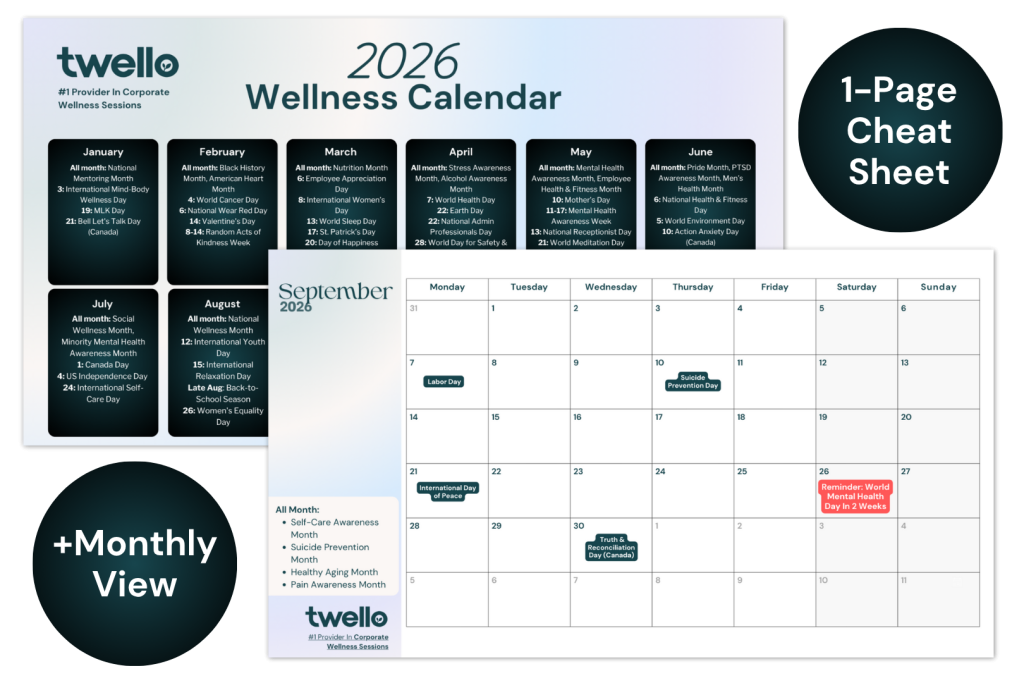
2026 Workplace Awareness Days Calendar (At-A-Glance)
May 2026
| Most Commonly Celebrated ✨ | Just-for-Fun Moments 🎉 | Cultural & Religious Observances 🌍 | Additional Observances 🔎 |
|---|---|---|---|
|
The big moments we see HR teams plan for most often.
|
Optional morale-boosters that are easy to sprinkle in.
|
Meaningful and team-specific. Handle with care.
|
Additional observances that may be especially relevant for specific communities or roles.
|
How HR Teams Should Plan May Workplace Wellness Programs
Primary focus: Mental health, stress regulation, and sustainable habits
Best weeks to activate: Weeks 2–4 (avoid front-loading everything)
Ideal number of initiatives: 4–8 intentional touchpoints
May works best when programming is spread out and intentional — not packed into a single week.
Teams are often balancing heavier workloads, personal stressors, and mid-year fatigue. The goal is to make support visible, practical, and easy to engage with — not overwhelming or performative.
Best Workplace Wellness Themes for Employee Engagement in May
The most effective May programming is practical, supportive, and easy to engage with.
Instead of treating mental health as a one-off campaign, anchor your planning around three outcomes:
- Mental health visibility: Use Mental Health Awareness Month to normalize the conversation and make support easier to access.
- Stress regulation: Focus on tools employees can actually use during the workday to reduce tension and improve resilience.
- Sustainable habits: Tie into Employee Health & Fitness Month with realistic topics like movement, sleep, nutrition, and recovery.
If an initiative feels performative, overly packed, or hard to engage with, it probably doesn’t need to be on the May calendar.
How People & Culture Teams Use May to Support Employee Wellbeing
Strong People & Culture teams use May as a foundation month, not a finish line.
In practice, that looks like:
- Spacing programming across Weeks 2–4 instead of concentrating everything into Mental Health Awareness Week.
- Using 4–8 touchpoints across the month, combining education, light engagement, and visible support.
- Building in moments that reinforce psychological safety, burnout prevention, and values-aligned care.
When May feels thoughtful and human, employees remember it long after the month ends.
Common Mistakes to Avoid in May Workplace Wellness Programs
- Overloading calendars with daily initiatives: More activity does not automatically mean more support.
- Performative mental health messaging: Employees notice when the message is louder than the actual support.
- Mandatory or forced participation: Mental health support should feel safe and optional.
- Treating mental health as a single event: May should reinforce ongoing support, not check a box.
As always, May wellness should reduce pressure — not add to it.
How To Celebrate May’s Biggest Workplace Observances
🧠 Mental Health Awareness Month at Work: Ideas for HR Teams (May 2026)
Quick take: Mental Health Awareness Month should make support visible and usable — not just talked about.
What to focus on
- Normalize the conversation: Treat mental health as part of everyday work, not a special topic.
- Prioritize practical tools: Focus on what employees can actually use between meetings.
- Consistency over intensity: A few well-spaced touchpoints outperform one large campaign.
Low-lift ideas
- Anchor (30 minutes): Run a Break the Stress Cycle or Understanding Anxiety session early in the month.
- Weekly rhythm: Share one simple, actionable tool each week (e.g., “how to reset between meetings”).
- Leadership signal: Have leaders model boundaries (logging off, taking breaks) in a visible way.
- Light structure: Offer optional drop-in sessions rather than mandatory programming.
What to avoid
- Making mental health a one-time event instead of ongoing support
- Overloading employees with too many sessions in one week
- Messaging without actual resources or follow-through
🏃 Employee Health & Fitness Month at Work: HR-Friendly Ideas (May 2026)
Quick take: This month should make movement feel easy to start and easy to stick with — not intense or competitive.
What to focus on
- Lower the barrier: Keep movement short, accessible, and doable during work hours.
- Consistency over challenge: Daily small actions beat one big push.
- Inclusive design: Ensure all fitness levels and abilities feel welcome.
Low-lift ideas
- Anchor (30 minutes): Offer a Chair Yoga or Stretch & Soothe session mid-month.
- Movement moments: Encourage 5–10 minute breaks between meetings or at set times.
- Habit stacking: Tie movement to existing routines (e.g., “walk during your 1:1”).
- Light engagement: Optional step or movement tracking — no leaderboards required.
What to avoid
- High-intensity or competitive challenges that exclude people
- Framing fitness as a performance metric
- Expecting employees to participate outside working hours
🧠 Mental Health Awareness Week Workplace Ideas (Canada, May 4–10, 2026)
Quick take: This week should deepen support — not compress everything into five days.
What to focus on
- Pace the week: Space sessions instead of scheduling daily back-to-back events.
- Mix formats: Combine education, reflection, and light engagement.
- Keep it optional: Psychological safety comes from choice, not pressure.
Low-lift ideas
- Anchor (30 minutes): Host a Mindfulness 101 session or guided reset mid-week.
- Theme days (light): Assign simple daily themes (e.g., rest, connection, focus) without heavy programming.
- Manager enablement: Provide 1–2 conversation prompts managers can use in team check-ins.
- Quiet support: Share resources employees can explore privately.
What to avoid
- Scheduling a full week of mandatory sessions
- Forcing participation in sensitive conversations
- Treating the week as a replacement for month-long support
How to celebrate Mother’s Day at Work (May 10, 2026)
Quick take: Mother’s Day should be acknowledged with care and inclusivity – offering support without assumptions or pressure.
What to focus on
- Keep it inclusive: Recognize that this day can hold different meanings – appreciation, grief, complexity, or neutrality.
- Support caregivers broadly: Expand the lens beyond mothers to include caregivers too.
- Offer flexibility: Give employees space to engage with the day in a way that feels right for them.
Low-lift ideas
- Optional acknowledgement: Share a short, thoughtful message that centers appreciation without expectation.
- Flexible time: Allow employees to adjust their schedules to spend more time with loved ones.
- Wellness support: Offer a session like Balance for Parents and Caregivers to support those navigating caregiving responsibilities with work.
What to avoid
- Making assumptions about employees’ relationships with motherhood
- Overly celebratory or one-size-fits-all messaging
- Mandatory participation in Mother’s Day-related activities
How to Observe Memorial Day at Work (US, May 25, 2026)
Quick take: Memorial Day should be acknowledged with respect and simplicity — not programming.
What to focus on
- Keep it minimal: A short, thoughtful acknowledgment is enough.
- Respect the tone: This is not a celebratory or engagement-driven moment.
- Encourage real rest: Support employees in actually taking time off.
Low-lift ideas
- Leadership message: Share a brief, respectful note of gratitude.
- Calendar protection: Avoid scheduling meetings or initiatives around the holiday.
- Culture signal: Encourage teams to fully disconnect if possible.
What to avoid
- Over-programming or turning the day into an event
- Overly branded or performative messaging
- Blending the day with unrelated wellness initiatives
May Wellness Activations: What to Pair With Key Dates
If you’re planning 4–8 touchpoints in May, tie them to moments employees already recognize. This keeps programming timely, easier to explain internally, and more likely to get real engagement.
Below are high-performing wellness pairings based on what HR teams are most likely to book for May themes.
| Wellness Observance | Theme | Recommended Wellness Workshop | Why It Works |
|---|---|---|---|
|
Mental Health Awareness Month
All Month
|
Mental Health |
or
|
These are two of the clearest, most credible anchors for May. They help teams normalize mental health conversations without making programming feel heavy or performative. |
|
Employee Health & Fitness Month
All Month
|
Healthy Habits |
or
|
Works well for teams that want practical wellness without turning the month into a fitness challenge. Both options are accessible, easy to position, and useful for busy employees. |
|
Mental Health Awareness Week
Canada, May 4–10, 2026
|
Stress Support |
or
|
A strong fit for the week when teams want something a little more focused, but still low-pressure. Both topics are timely for mid-year fatigue and easy to justify as real employee support. |
|
National Receptionist Day
May 13, 2026
|
Recognition |
or
|
Recognition lands better when it feels thoughtful and restorative, not generic. This pairing works especially well for teams supporting everyone else behind the scenes. |
If you only plan one initiative in May, prioritize Mental Health Awareness Month. It is the clearest strategic fit for the month and gives you the most flexibility in how you position support.
Typical virtual budget range: $400–$600 for up to 200 attendees. Onsite classes are available in select cities.
The 7-Day Activation Plan (No Chaos Required)
You do not need a huge campaign to make May programming land well. Just a simple, intentional rhythm.
- 7+ days out: Choose your workshop and lock in the date. Book here.
- 5+ days out: Send a short invite or announcement.
- 2 days out: Send a quick reminder.
- Event day: Let the session do the heavy lifting.
No complicated rollout. No overloaded calendar. Just timely, credible programming your team can actually use.
May Wellness Activations: What to Pair With Key Dates
If you’re planning 4–8 touchpoints in May, tie them to moments employees already recognize. This keeps programming timely, easier to explain internally, and more likely to get real engagement.
Below are high-performing wellness pairings based on what HR teams are most likely to book for May themes.
Mental Health Awareness Month
All Month
These are two of the clearest, most credible anchors for May.
They help teams normalize mental health conversations without making programming feel heavy or performative.
Employee Health & Fitness Month
All Month
Works well for teams that want practical wellness without turning the month into a fitness challenge.
Both options are accessible, easy to position, and useful for busy employees.
Mental Health Awareness Week
Canada, May 4–10, 2026
A strong fit for the week when teams want something a little more focused, but still low-pressure.
Both topics are timely for mid-year fatigue and easy to justify as real employee support.
National Receptionist Day
May 13, 2026
Recognition lands better when it feels thoughtful and restorative, not generic.
This pairing works especially well for teams supporting everyone else behind the scenes.
If you only plan one initiative in May, prioritize Mental Health Awareness Month. It is the clearest strategic fit for the month and gives you the most flexibility in how you position support.
Typical virtual budget range: $400–$600 for up to 200 attendees. Onsite classes are available in select cities.
The 7-Day Activation Plan (No Chaos Required)
You do not need a huge campaign to make May programming land well. Just a simple, intentional rhythm.
- 7+ days out: Choose your workshop and lock in the date. Book a consultation if you'd like a tailored recommendation. Book here.
- 5+ days out: Send a short invite or announcement.
- 2 days out: Send a quick reminder.
- Event day: Let the session do the heavy lifting.
No complicated rollout. No overloaded calendar. Just timely, credible programming your team can actually use.
Just for Fun: Quirky May Workplace Holidays
These work best as Slack moments or coffee-break boosters, no need for a full event.
- Star Wars Day (May 4): Keep it casual with a “May the Fourth be with you” Slack post, a movie gif thread, or a poll on everyone’s favorite character. Easy, silly, and low-stakes.
- Cinco de Mayo (May 5): Keep this one simple and respectful. A light food-themed Slack thread like “what’s your ideal taco order?” works better than turning it into a faux cultural celebration.
- National Smile Day (May 31): Use it as a quick positivity prompt. Ask people to share one thing that made them laugh recently or a tiny win from the week.
Light moments matter, especially in busy months like May.
Explore More HR Awareness Calendars by Month

Author: Kayla Baum
Founder & CEO, Twello
Kayla Baum is the Founder & CEO of Twello, where she’s helped more than 1,100 organizations (maybe 1,200 now?), including
KPMG, Amazon, Capital One, and CARE International bring practical, evidence-based wellness into the workday.
Working closely with HR and People & Culture teams every day gives her a grounded perspective on what
actually supports employee well-being (and what never gets used).
Each date on this awareness calendar is vetted through leading health agencies and long-standing
observance organizations, then filtered through Twello’s real-world experience of what workplaces can
realistically acknowledge. No noise. No gimmick days. Just what matters for teams.
Areas of Expertise
Bring Your Workplace Wellness Days To Life
Have questions about workshops, wellness programming, or how to to celebrate?
Fill out the form, and we’ll send over pricing, class recommendations, and samples.
Frequently Asked Questions
May Workplace Wellness FAQ
What Are The Most Important Awareness Days In May For HR Teams?
The most important May observances are Mental Health Awareness Month, Employee Health & Fitness Month, Mental Health Awareness Week (Canada, May 4–10), and Memorial Day (US, May 25).
How Many Wellness Initiatives Should HR Plan In May?
Most teams run 4–8 initiatives across the month. That could look like 1–2 live sessions, a few lightweight Slack or email prompts, and one focused week of programming.
Spacing things out across Weeks 2–4 tends to drive better engagement than clustering everything early.
What Are Simple Workplace Wellness Ideas For May?
Keep it low-lift and consistent: one anchor session (like a stress or mindfulness workshop), plus weekly micro-actions such as sharing a quick reset technique or encouraging short movement breaks.
You can also layer in a single themed week (Mental Health Awareness Week) without overloading the calendar. The goal is steady, visible support—not a packed schedule.
How Do You Celebrate Mental Health Awareness Month at work?
Focus on making mental health support visible and usable.
A strong approach is one anchor session (like Understanding Anxiety or Break the Stress Cycle), plus weekly tools employees can actually apply during the workday. Pair that with simple leadership signals—like encouraging breaks or flexible time—to reinforce that the message is real.
Why Is May Important For Workplace Wellness?
May is the most visible month for mental health at work, making it a key opportunity to normalize conversations and reinforce support. It also helps address mid-year fatigue and early burnout signals before summer.
When done well, it sets the tone for how your organization approaches well-being year-round.
What’s The Easiest Way To Plan May Wellness Programming?
Start with one anchor (Mental Health Awareness Month), add one focused week (Mental Health Awareness Week), and layer in a few small touchpoints like Slack prompts or short resets.
Keep everything optional and easy to engage with. This gives you a complete plan without overbuilding it.
Can Twello Help Us Celebrate Or Activate These Awareness Days?
Yes! Twello offers ready-to-run sessions aligned with key awareness moments, so HR and People teams can acknowledge important dates without scrambling. Check out our entire catalog here.
Can I download the 2026 calendar as a PDF?
Yep, in one click!
The PDF includes a 1-page cheat sheet and the full calendar with room for notes, so you can sketch ideas or flag dates for specific departments. Download here.