October Awareness Days for HR: Workplace Wellness & Employee Engagement Ideas (2026)
(Without Making More Work For You)
Key Takeaways
- October is about emotional well-being, prevention, and sustainable support, not piling on heavy initiatives before year-end.
- The most effective October programming balances mental health visibility, healthy workplace habits, and human connection.
- Aim for 2–3 intentional, supportive initiatives across the month.
- Key moments include Emotional Wellness Month, Healthy Workplace Month, Breast Cancer Awareness Month, World Mental Health Day (October 10), Canadian Thanksgiving (October 12), and Halloween (October 31).
Who This October HR Calendar Is For
This October workplace wellness guide is designed for:
- HR Leaders
- People & Culture Teams
- Office & Workplace Experience Managers
- Executive Assistants
- Wellness Committees
- DEI and ERG Committees
If you’re responsible for planning October awareness days, employee engagement moments, or wellness programming, this guide is here to save you time, energy, and second-guessing.
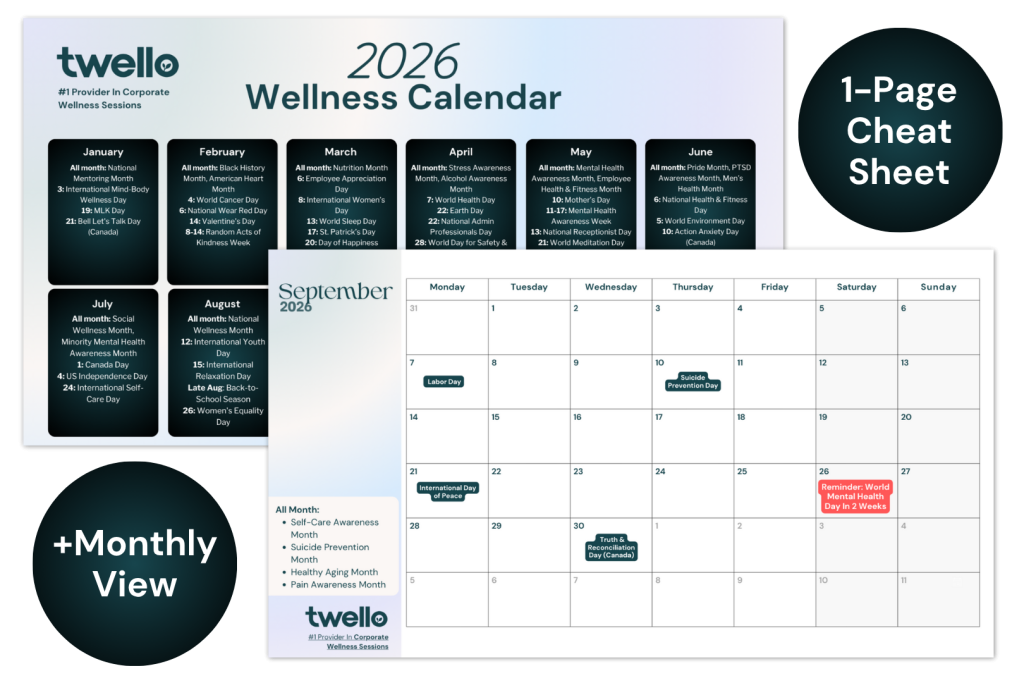
If you’re building a larger engagement strategy for the year, our 2026 Workplace Wellness Calendar can help with additional planning ideas.
Download The Full 2026 Calendar (PDF)
All the important days. None of the “wear a silly hat” days. Plan the whole year in 30 minutes.
Download
2026 Workplace Awareness Days Calendar (At-A-Glance)
October 2026
| Most Commonly Celebrated ✨ | Just-for-Fun Moments 🎉 | Cultural & Religious Observances 🌍 | Additional Observances 🔎 |
|---|---|---|---|
|
The big moments we see HR teams plan for most often.
|
Optional morale-boosters that are easy to sprinkle in.
|
Meaningful and team-specific. Handle with care.
|
Additional observances that may be relevant for specific communities.
|
How HR Teams Should Plan October Workplace Wellness Programs
- Primary focus: Emotional well-being, mental health, and workplace culture
- Best weeks to activate: Weeks 2–3 (before end-of-month crunch)
- Ideal number of initiatives: 2–3 meaningful touchpoints
October is a mental health anchor month. Teams are often balancing heavier workloads, personal stress, and Q4 planning. The goal is to help employees feel supported and steady — not analyzed, fixed, or overwhelmed with programming.
Best October Workplace Wellness Themes for Employee Engagement
The most effective October programming is supportive, practical, and stigma-free. Instead of broad campaigns, anchor your planning around three outcomes:
- Mental health normalization: Use World Mental Health Day (October 10) as your anchor. Focus on everyday support, manager guidance, and clear resource-sharing.
- Emotional regulation: Tie into Emotional Wellness Month with simple tools employees can use during high-pressure workdays.
- Healthy workplace culture: Use Healthy Workplace Month to reinforce psychological safety, flexibility, and sustainable ways of working.
If an initiative feels performative or too heavy for employees to opt into safely, it probably doesn’t belong on the October calendar.
How People & Culture Teams Use October to Support Employee Wellbeing
Strong People & Culture teams use October to signal care and commitment, not add pressure.
In practice, that looks like:
- Scheduling one mental health session around World Mental Health Day.
- Offering one emotional wellness or stress-regulation session mid-month.
- Adding one lighter culture moment, such as gratitude around Canadian Thanksgiving or a low-pressure Halloween activity.
When October feels grounded and compassionate, teams are better equipped to finish the year strong.
Common Mistakes to Avoid in October Workplace Wellness Programs
- Treating World Mental Health Day as a checkbox: Employees notice when support is only visible for one day.
- Overloading the month with heavy content: Too many serious touchpoints can create emotional fatigue.
- Making sensitive topics mandatory: Participation should be optional, especially around mental health and personal experiences.
- Framing wellness as “fixing” employees: October wellness should reduce stigma, not put pressure on people to disclose or improve.
As always, October wellness should feel safe, optional, and stigma-free.


Lets Chat Wellness For Your Team.
- Wellness Classes Your Team Will Actually Enjoy
- Serving Global Teams - Onsite, Virtual & Hybrid
- We Handle Everything - Seamless Planning

How To Celebrate October’s Biggest Observances
🧠 How to Celebrate Emotional Wellness Month at Work (October 2026)
Quick take: Emotional Wellness Month is a useful anchor for helping employees name, understand, and regulate stress before year-end pressure builds. Keep it practical: the goal is steadier workdays, not forced vulnerability.
What to anchor on
- Normalize emotional load: Acknowledge that Q4 can feel heavy without turning the month into a therapy campaign.
- Focus on regulation: Prioritize tools employees can use between meetings, after hard conversations, or during high-pressure weeks.
- Make participation private-friendly: Not every employee wants to share how they feel at work, and they shouldn’t have to.
Low-lift ideas
- Anchor: Host a 30-minute wellness session such as Break the Stress Cycle, Understanding Anxiety, Self-Care for Stress Reduction, or Resilience Training.
- Weekly reset prompt: Share one short reflection question each week, such as “What helped you feel steady this week?”
- Culture signal: Encourage managers to protect breaks, reduce unnecessary urgency, and model realistic response-time expectations.
What to avoid
- Asking employees to publicly share personal emotions or mental health experiences
- Using vague “check in on yourself” messaging without offering practical tools
- Positioning emotional wellness as an individual responsibility while ignoring workload pressure
🏢 How to Celebrate Healthy Workplace Month at Work (October 2026)
Quick take: Healthy Workplace Month at Work highlights the importance of practicing habits that promote a healthy mind, body, and organizational culture.
What to anchor on
- Look at systems: Healthy workplaces are shaped by expectations, communication norms, and leadership behavior.
- Keep health inclusive: Avoid weight, step-count, or appearance-based programming that can exclude or shame employees.
- Reduce friction: Focus on small changes that make the workday easier to sustain.
Low-lift ideas
- Anchor (30 minutes): Offer Creating Psychological Safety, Stretch & Soothe, Emotional Intelligence 101, or Workplace Communication.
- Workday audit: Ask teams to identify one meeting, process, or expectation that could be simplified this month.
- Ergonomic reset: Share simple workstation, posture, and movement-break tips for office, hybrid, and remote employees.
What to avoid
- Running competitive wellness challenges that reward only the most active employees
- Treating “healthy workplace” as a benefits message instead of a culture conversation
- Adding programming without removing any friction from the workday
🎗️ How to Acknowledge Breast Cancer Awareness Month at Work (October 2026)
Quick take: Breast Cancer Awareness Month should be handled with care, clarity, and choice. Keep the focus on education, early detection, support, and empathy.
What to anchor on
- Lead with credible information: Share screening and early-detection resources from trusted health organizations.
- Make support visible: Remind employees how to access benefits, leave policies, EAP support, or accommodations privately.
- Respect lived experience: Employees may be survivors, caregivers, grieving, or currently in treatment.
Low-lift ideas
- Resource share: Send a concise email with screening reminders, benefit links, and support resources employees can access privately.
- Optional giving: Highlight a credible nonprofit or local initiative without making participation performative.
- Manager reminder: Encourage flexibility and discretion when employees are navigating medical appointments, caregiving, or treatment-related needs.
What to avoid
- Using pink-themed activities without meaningful education or support
- Asking employees to disclose personal cancer experiences
- Turning a serious health observance into a morale campaign
♿ How to Recognize National Disability Employment Awareness Month at Work (October 2026)
Quick take: National Disability Employment Awareness Month is a chance to move beyond awareness and look at access, belonging, and workplace design. The strongest approach is practical, not performative.
What to anchor on
- Center access: Review the systems that shape how employees participate, communicate, and succeed.
- Normalize accommodations: Accommodations are not special treatment; they are part of equitable workplace design.
- Include invisible disabilities: Disability is not always visible, disclosed, or linear.
Low-lift ideas
- Accessibility check: Review meeting norms, captions, document formatting, and event access basics.
- Manager guidance: Share a short reminder on respectful accommodation conversations and privacy.
- Culture signal: Invite employees to request what helps them participate fully, without requiring disclosure or explanation.
What to avoid
- Using inspirational disability stories as the main message
- Talking about inclusion without reviewing actual workplace barriers
- Putting the burden on disabled employees to educate the organization
💚 How to Support Mental Illness Awareness Week at Work (Oct 4–10, 2026)
Quick take: Mental Illness Awareness Week should reduce stigma without asking employees to disclose. Keep the tone grounded, resource-forward, and respectful.
What to anchor on
- Separate awareness from disclosure: Employees can benefit from support without sharing personal experiences.
- Make resources easy to find: This is a good week to clarify where support lives and how to access it confidentially.
- Support managers: Leaders need guidance on how to respond with care without becoming clinicians.
Low-lift ideas
- Anchor: Host a 30-minute workshop such as Understanding Anxiety, Break the Stress Cycle, Preventing Burnout, or Creating Psychological Safety.
- Resource refresh: Re-share EAP, crisis, benefits, and leave resources in one simple internal post.
- Manager script: Provide a few phrases leaders can use when someone seems overwhelmed, such as “What support would help right now?”
What to avoid
- Making mental health content overly clinical or fear-based
- Asking managers to diagnose, counsel, or solve employee mental health issues
- Only talking about mental health during one awareness week
🌍 How to Celebrate World Mental Health Day at Work (October 10, 2026)
Quick take: World Mental Health Day is one of the most visible workplace wellness moments of the year, but visibility only matters when it is paired with action. Use the day to make support easier to access and safer to talk about.
What to anchor on
- Move beyond awareness: Employees need clear resources, supportive norms, and leaders who know how to respond.
- Keep it stigma-free: Mental health messaging should be calm, practical, and non-performative.
- Protect choice: Employees should be able to engage privately, quietly, or not at all.
Low-lift ideas
- Anchor: Host a 30-minute workshop such as Understanding Anxiety, Break the Stress Cycle, Preventing Burnout, Creating Psychological Safety, or Positive Mental Health in the Winter.
- Resource hub: Share one simple, private-access list of benefits, EAP details, crisis resources, leave options, and manager contacts.
- Leadership note: Ask one senior leader to share a grounded message about support, workload sustainability, and asking for help early.
What to avoid
- Treating World Mental Health Day as a one-day checkbox
- Using vulnerable employee stories as engagement content
- Sharing resources without making them easy to find, use, or trust
🍁 How to Celebrate Canadian Thanksgiving at Work (October 12, 2026)
Quick take: Canadian Thanksgiving can be a simple moment for gratitude and rest, especially for Canadian teams. Keep it thoughtful, optional, and respectful of different relationships to the holiday.
What to anchor on
- Keep gratitude specific: Appreciation should name real contributions, not rely on generic “we’re thankful for you” language.
- Protect rest: The most meaningful signal may be fewer messages, fewer meetings, and real time away.
- Be culturally aware: Avoid assuming the holiday carries the same meaning for everyone.
Low-lift ideas
- Leadership message: Send a short, specific note recognizing team effort and encouraging true time off.
- Team appreciation: Invite employees to share peer shoutouts before the long weekend, with no pressure to participate.
- Calendar hygiene: Reduce meetings and non-urgent deadlines around the holiday for Canadian employees where possible.
What to avoid
- Turning gratitude into mandatory sharing
- Scheduling “celebration” activities that create more work before a long weekend
- Ignoring regional differences across North American teams
October Wellness Activations: What to Pair With Key Dates
If you’re planning 2–3 initiatives in October, anchor them to moments employees already recognize. This keeps mental health support visible without overloading the month.
Below are high-performing wellness pairings based on what HR teams are most likely to book for October themes.
| Wellness Observance | Theme | Recommended Wellness Workshop | Why It Works |
|---|---|---|---|
|
Emotional Wellness Month
All Month
|
Emotional Regulation |
or
|
Directly supports October’s emotional well-being focus without requiring employees to disclose anything personal. Practical, low-pressure tools help teams reset before year-end intensity builds. |
|
Healthy Workplace Month
All Month
|
Healthy Culture |
or
|
Shifts the focus from individual wellness habits to the conditions that help people work sustainably. Strong fit for teams that want to address culture, workload, and trust in a credible way. |
|
Breast Cancer Awareness Month
All Month
|
Care & Support |
|
This observance is best handled through credible education, screening resources, benefits reminders, and optional support. A respectful communication moment is usually more appropriate than wellness programming. |
|
World Mental Health Day
October 10, 2026
|
Mental Health Support |
or
|
One of October’s strongest anchors for visible, stigma-free mental health support. Works best when paired with clear resources, manager guidance, and optional participation. |
|
Canadian Thanksgiving
October 12, 2026
|
Gratitude & Rest |
or
|
Connects appreciation with real rest, especially for Canadian teams heading into a long weekend. A light, restorative session keeps the tone supportive without making gratitude feel forced. |
|
Halloween
October 31, 2026
|
Connection & Fun |
|
Halloween is best used as a light engagement moment, not a wellness workshop anchor. Keep it optional, inclusive, and easy for hybrid or remote employees to join. |
If you only plan one initiative in October, prioritize World Mental Health Day or Emotional Wellness Month. They are the clearest thematic fits and easiest to position as timely, meaningful support.
Typical virtual budget range: $400–$600 for up to 200 attendees. Onsite classes are available in select cities.
The 7-Day Activation Plan (No Chaos Required)
You do not need a huge campaign to make October programming land well. Just a simple rhythm.
- 7+ days out: Choose your workshop and lock in the date. Book a consultation if you'd like a tailored recommendation. Book here.
- 5+ days out: Send a short invite or announcement. Keep it clear: what it is, how long it is, and why it is worth stepping away from work for 30 minutes.
- 2 days out: Send a quick reminder with what to expect, cameras-optional reassurance, and a simple note that participation is encouraged but low-pressure.
- Event day: Sit back and relax.
No complicated rollout. No overbuilt campaign. Just timely, supportive programming your team can actually use.
October Wellness Activations: What to Pair With Key Dates
If you’re planning 2–3 initiatives in October, anchor them to moments employees already recognize. This keeps mental health support visible without overloading the month.
Below are high-performing wellness pairings based on what HR teams are most likely to book for October themes.
Emotional Wellness Month
All Month
Directly supports October’s emotional well-being focus without requiring employees to disclose anything personal.
Practical, low-pressure tools help teams reset before year-end intensity builds.
Healthy Workplace Month
All Month
Shifts the focus from individual wellness habits to the conditions that help people work sustainably.
Strong fit for teams that want to address culture, workload, and trust in a credible way.
Breast Cancer Awareness Month
All Month
- No workshop recommended
This observance is best handled through credible education, screening resources, benefits reminders, and optional support.
A respectful communication moment is usually more appropriate than wellness programming.
World Mental Health Day
October 10, 2026
One of October’s strongest anchors for visible, stigma-free mental health support.
Works best when paired with clear resources, manager guidance, and optional participation.
Canadian Thanksgiving
October 12, 2026
Connects appreciation with real rest, especially for Canadian teams heading into a long weekend.
A light, restorative session keeps the tone supportive without making gratitude feel forced.
Halloween
October 31, 2026
- No workshop recommended
Halloween is best used as a light engagement moment, not a wellness workshop anchor.
Keep it optional, inclusive, and easy for hybrid or remote employees to join.
If you only plan one initiative in October, prioritize World Mental Health Day or Emotional Wellness Month. They are the clearest thematic fits and easiest to position as timely, meaningful support.
Typical virtual budget range: $400–$600 for up to 200 attendees. Onsite classes are available in select cities.
The 7-Day Activation Plan (No Chaos Required)
You do not need a huge campaign to make October programming land well. Just a simple rhythm.
- 7+ days out: Choose your workshop and lock in the date. Book a consultation if you'd like a tailored recommendation. Book here.
- 5+ days out: Send a short invite or announcement. Keep it clear: what it is, how long it is, and why it is worth stepping away from work for 30 minutes.
- 2 days out: Send a quick reminder with what to expect, cameras-optional reassurance, and a simple note that participation is encouraged but low-pressure.
- Event day: Sit back and relax.
No complicated rollout. No overbuilt campaign. Just timely, supportive programming your team can actually use.

Book your team's wellness sessions today.
Choose the sessions that fit your team, pick your dates, and check out securely – all in one place.
Just for Fun: Quirky October Workplace Holidays
These work best as Slack moments or coffee-break boosters, no need for a full event.
- World Smile Day (October 2): Share a feel-good story, customer win, or colleague shout-out to spread a little positivity across the team.
- World Animal Day (October 4): Invite employees to post pet photos or introduce their favorite animal companion in Slack or Teams. An easy, reliable morale booster.
- Halloween (October 31): Keep it optional and inclusive with costume photos, themed virtual backgrounds, desk decorations, or a “guess the childhood costume” Slack thread.
Light moments matter, especially during a busy month like October.
Explore More HR Awareness Calendars by Month
Frequently Asked Questions
October Workplace Wellness FAQ
What Are The Most Important Awareness Days In October For HR Teams?
October’s key workplace wellness observances include Emotional Wellness Month, Healthy Workplace Month, Breast Cancer Awareness Month, World Mental Health Day (October 10), Canadian Thanksgiving (October 12), and Halloween (October 31). Together, they create a balanced month that combines meaningful mental health support with lighter moments that strengthen workplace culture.
What Are Simple Workplace Wellness Ideas For October?
Keep October simple with two or three intentional touchpoints. A mental health workshop, a manager resource share, a gratitude message around Canadian Thanksgiving, and a fun Halloween Slack activity are all low-lift ways to support employees without overwhelming the calendar.
How Many Wellness Initiatives Should HR Plan In October?
For most organizations, two to three initiatives are enough. A month-long awareness campaign paired with one educational workshop and one light engagement activity keeps programming visible while respecting employees’ time and workloads.
How Do You Celebrate World Mental Health Day?
Focus on making support visible rather than creating a one-day campaign. Offer a mental health or psychological safety workshop, remind employees about available resources, and encourage leaders to reinforce a culture where asking for support feels normal and stigma-free.
What Are Good Healthy Workplace Month Ideas For The Workplace?
Healthy Workplace Month is a great opportunity to improve the work environment rather than promote wellness challenges. Consider ergonomic reminders, burnout prevention sessions, psychological safety training, or simple conversations about workload, boundaries, and sustainable work habits.
How Can HR Celebrate Emotional Wellness Month?
Focus on practical emotional well-being rather than personal disclosure. Workshops on stress regulation, mindfulness, or emotional resilience, combined with weekly reflection prompts or manager check-ins, help normalize everyday mental health support in a respectful, low-pressure way.
Can Twello Help Us Celebrate Or Activate These Awareness Days?
Of course! We offer workshops and ready-to-run activities aligned with many major observances, so HR and People teams can acknowledge important dates without scrambling. Check out our entire catalog here: https://catalog.trytwello.com/
Can I download the 2026 calendar as a PDF?
Yep, in one click!
The PDF includes a 1-page cheat sheet and the full calendar with room for notes, so you can sketch ideas or flag dates for specific departments. Download here.

Author: Kayla Baum
Founder & CEO, Twello
Kayla Baum is the Founder & CEO of Twello, where she’s helped more than 1,100 organizations (maybe 1,200 now?), including
KPMG, Amazon, Capital One, and CARE International bring practical, evidence-based wellness into the workday.
Working closely with HR and People & Culture teams every day gives her a grounded perspective on what
actually supports employee well-being (and what never gets used).
Each date on this awareness calendar is vetted through leading health agencies and long-standing
observance organizations, then filtered through Twello’s real-world experience of what workplaces can
realistically acknowledge. No noise. No gimmick days. Just what matters for teams.
Areas of Expertise
Bring Your Workplace Wellness Days to Life
Have questions about workshops, wellness programming, or how to celebrate?
Fill out the form, and we’ll send over pricing, class recommendations, and samples!