July Awareness Days for HR: Workplace Wellness & Employee Engagement Ideas [2026]
(Without Making More Work For You)
Key Takeaways
- July is about connection, self-care, and social wellbeing, not pushing peak productivity during a high-PTO season.
- The most important July awareness days for HR are Social Wellness Month, Minority Mental Health Awareness Month, International Self-Care Day, Canada Day, and Independence Day.
- Most teams benefit from 2–4 simple touchpoints rather than large events.
- Focus on relationship-building, recovery, and inclusive wellbeing support.
Who This July HR Calendar Is For
This July workplace wellness guide is designed for:
- HR Leaders
- People & Culture Teams
- Office & Workplace Experience Managers
- Executive Assistants
- Wellness Committees
- DEI and ERG Committees
If you’re planning July awareness days, employee engagement moments, or wellness programming, this guide is here to save you time, energy, and second-guessing.
If you’re building a larger engagement strategy for the year, our 2026 Workplace Wellness Calendar can help with additional planning ideas.
Download The Full 2026 Calendar (PDF)
All the important days. None of the “wear a silly hat” days. Plan the whole year in 30 minutes.
Download
2026 Workplace Awareness Days Calendar (At-A-Glance)
July 2026
| Most Commonly Celebrated ✨ | Just-for-Fun Moments 🎉 | Cultural & Religious Observances 🌍 | Additional Observances 🔎 |
|---|---|---|---|
|
The big moments we see HR teams plan for most often.
|
Optional morale-boosters that are easy to sprinkle in.
|
Meaningful and team-specific. Handle with care.
|
Additional observances that may be especially relevant for specific communities or roles.
|
How HR Teams Should Plan July Workplace Wellness Programs
Primary focus: Social connection, recovery, and flexible support during peak PTO season
Best weeks to activate: Weeks 2–4 (after holiday closures, before late-month vacation gaps)
Ideal number of initiatives: 2–3 low-lift touchpoints
July is often shaped by PTO schedules, lighter attendance, and shifting team routines. The most successful July programs focus on helping employees stay connected without adding more meetings or obligations.
Why July Awareness Days Matter for HR Teams
July awareness days give HR teams an easy way to keep employee engagement visible during a month when many employees are away, distracted, or balancing summer schedules.
They can help:
- Maintain team connection during vacation season
- Support employee wellbeing and recovery
- Encourage inclusion and belonging
- Create low-pressure engagement opportunities
- Keep wellness initiatives visible throughout the summer
Best July Workplace Wellness Themes for Employee Engagement
The most effective July programming is simple, social, and easy to join. Instead of broad campaigns, anchor your planning around three outcomes:
- Connection: Use Social Wellness Month as your anchor. Prioritize small moments that help colleagues reconnect without forcing extra time commitments.
- Inclusive support: Tie into Minority Mental Health Awareness Month with resources and conversations that reflect different lived experiences.
- Recovery: Use International Self-Care Day (Jul 24) to reinforce boundaries, rest, and realistic ways to recharge during the workweek.
If an initiative feels heavy, high-effort, or too dependent on full attendance, it probably doesn’t need to be on the July calendar.
How People & Culture Teams Use July to Support Employee Wellbeing
Strong People & Culture teams use July to maintain connection, not fill the calendar.
In practice, that looks like:
- Scheduling one light social or team-connection moment early to mid-month.
- Offering one inclusive mental health resource, session, or content touchpoint tied to Minority Mental Health Awareness Month.
- Adding one simple self-care or boundary-setting moment around International Self-Care Day.
When July feels flexible and low-pressure, teams stay connected without making summer schedules harder to navigate.
Common Mistakes to Avoid in July Workplace Wellness Programs
- Over-programming during vacation season: A packed calendar usually leads to low participation and unnecessary pressure.
- Assuming everyone relates to summer the same way: Keep seasonal messaging inclusive and optional.
- Treating connection like a mandatory team-building exercise: July works better when participation feels easy and natural.
- Forgetting schedule flexibility: Plan around holidays, PTO, and lighter attendance patterns.
As always, July wellness should make work feel more supportive — not more demanding.


Lets Chat Wellness For Your Team.
- Wellness Classes Your Team Will Actually Enjoy
- Serving Global Teams - Onsite, Virtual & Hybrid
- We Handle Everything - Seamless Planning

How To Celebrate July’s Biggest Observances
🤝 How to Celebrate Social Wellness Month at Work (July 2026)
Quick take: Social Wellness Month is not a mandate to make everyone more social. It is a chance to create lighter, lower-pressure ways for people to feel connected during a month when schedules are fragmented.
What to anchor on
- Make connection optional: The best July programming creates easy entry points, not attendance pressure. Think small, repeatable moments employees can join without disrupting their day.
- Design for different personalities: Strong teams do not treat connection as synonymous with extroversion. Quiet participation should feel just as valid as live interaction.
- Work with summer reality: PTO, flexible hours, and uneven attendance are normal in July. Choose formats that still work when not everyone is available at once.
Low-lift ideas
- Connection ritual: Add one optional weekly touchpoint like a 20-minute coffee chat block, rotating lunch table, or Slack prompt that helps people reconnect without turning it into a formal event.
- Culture signal: Start a simple peer recognition thread focused on appreciation, helpfulness, or collaboration — not performance. This works especially well in hybrid teams where day-to-day support is easy to miss.
- Shared experience: Invite employees to contribute to a team playlist, photo board, or “summer reset” recommendation list. It creates connection with almost no scheduling overhead.
What to avoid
- Forcing team bonding through mandatory fun or over-produced events
- Assuming high attendance is the goal during peak vacation season
- Defaulting to activities that only work well for highly social or in-office teams
🧩 How to Recognize Minority Mental Health Awareness Month at Work (July 2026)
Quick take: This month should prompt better support, not better optics. The goal is to make mental health resources feel more inclusive, credible, and easier to access for employees with different lived experiences.
What to anchor on
- Lead with access, not statements: Awareness matters, but employees benefit most when support pathways are clearer, more private, and easier to use.
- Respect lived experience: Strong HR teams avoid universal messaging that treats mental health as the same for everyone. Specificity builds trust.
- Use leaders carefully: The role of leadership is to reinforce safety, humility, and support — not to over-personalize or dominate the conversation.
Low-lift ideas
- Resource refresh: Audit and reshare mental health resources through an inclusion lens. Highlight culturally responsive providers, employee assistance options, and confidential ways to seek support.
- Manager guidance: Give people managers a short internal guide on how to respond supportively, avoid assumptions, and point employees toward resources without trying to “solve” everything themselves.
- Communication choice: Use a thoughtful written message that centers listening, access, and ongoing support. In most workplaces, this lands better than a broad, performative campaign.
What to avoid
- Using generic mental health messaging that ignores cultural context
- Asking employees to share personal stories to validate the observance
- Treating a single post or panel as proof of inclusive support
🍁 How to Celebrate Canada Day at Work (July 1, 2026)
Quick take: For Canadian teams, Canada Day works best as a light, respectful acknowledgment before the long weekend. Keep it simple, local, and optional.
What to anchor on
- Match the energy of the week: Early July is rarely the moment for a big activation. A small gesture is usually more appropriate than a company-wide production.
- Keep participation easy: Strong teams offer simple ways to join in, whether employees are remote, hybrid, or already mentally on holiday mode.
- Be thoughtful about tone: National celebrations can feel different across employees. Keep messaging warm and inclusive rather than overly patriotic or one-note.
Low-lift ideas
- Simple team moment: Share a short Canada Day note, add a red-and-white visual touch in Slack or the office, and keep any acknowledgment brief.
- Optional engagement: Run a lightweight Canadian trivia question, playlist share, or regional food prompt that teams can engage with asynchronously.
- Practical goodwill: Where possible, pair the day with an early sign-off, lighter meeting load, or explicit encouragement to unplug before the holiday.
What to avoid
- Turning the day into a required culture event
- Using overly heavy branding or messaging that excludes non-Canadian employees
- Scheduling something elaborate when attention is already on the long weekend
🇺🇸 How to Celebrate US Independence Day at Work (July 4, 2026)
Quick take: In most workplaces, July 4 is less about celebration programming and more about giving people breathing room. The smartest move is often to keep it minimal and support a clean lead-in to time off.
What to anchor on
- Prioritize ease over activity: Employees usually do not need another event before a holiday weekend. They need fewer meetings, clearer expectations, and less friction.
- Keep it optional and low-key: If you acknowledge the holiday, do it in a way that works for remote, hybrid, and in-office teams without requiring extra effort.
- Remember mixed teams: In global organizations, keep the tone locally relevant without assuming the observance applies equally to everyone.
Low-lift ideas
- Best-in-class move: Send a short holiday message and, if operationally possible, reduce the meeting load or encourage an early wrap-up before the holiday.
- Light office touch: For in-person teams, offer simple festive snacks or a casual themed moment that does not require a formal gathering.
- Manager cue: Encourage managers to avoid last-minute requests and to make priorities explicit so employees can actually log off cleanly.
What to avoid
- Planning attendance-dependent events right before the holiday
- Confusing festive energy with a need for more programming
- Ignoring the reality that many employees are already managing travel, family plans, or time away
🛁 How to Celebrate International Self-Care Day at Work (July 24, 2026)
Quick take: International Self-Care Day should reinforce that recovery belongs inside work culture, not outside it. The most useful observance is one that gives employees permission, structure, and practical ways to reset.
What to anchor on
- Focus on recovery, not aesthetics: Self-care at work is about boundaries, breaks, and sustainable energy — not polished routines or lifestyle branding.
- Make it doable during the workday: If support only works after hours, it is not especially supportive. Keep the ideas realistic for real schedules.
- Permission matters: Employees take cues from culture. Even simple signals from leaders can make rest feel more legitimate and less performative.
Low-lift ideas
- Anchor (30 minutes): Host a guided reset such as Chair Yoga, Meditation 101, or a simple boundaries-focused session if those class links are approved elsewhere in the blog.
- Protected block: Give employees one short “choose-your-own-reset” window during the day for a walk, stretch, quiet break, or actual screen-free time.
- Useful toolkit: Share a one-page self-care resource with realistic prompts like boundary-setting scripts, micro-break ideas, and recovery habits that fit into the workday.
What to avoid
- Reducing self-care to spa language, swag, or cosmetic perks
- Adding a wellness activity on top of an already overloaded day
- Sending “take care of yourself” messaging without protecting time or workload
♿ How to Celebrate Disability Independence Day at Work (July 26, 2026)
Quick take: Disability Independence Day is a strong moment to focus on access, autonomy, and workplace design. It should prompt practical inclusion work, not symbolic acknowledgment alone.
What to anchor on
- Center access: The most meaningful way to mark this day is to reduce friction in how people work, communicate, and participate.
- Think beyond compliance: Strong teams use moments like this to improve everyday experience, not just point to policy.
- Protect dignity and choice: Employees should never feel put on display or expected to educate others in order for the observance to feel real.
Low-lift ideas
- Accessibility check: Review a few basics this month, such as captioning practices, meeting accessibility, document readability, or how accommodation information is shared internally.
- Manager reminder: Give leaders a short refresher on inclusive meeting habits, flexible participation options, and how to respond appropriately to accommodation needs.
- Culture signal: Share a concise message that reinforces independence, access, and respect — and point employees to relevant policies or support channels without over-explaining.
What to avoid
- Making the day purely inspirational or symbolic
- Asking disabled employees to speak for an entire community
- Treating accessibility as a side topic instead of a normal part of workplace design
July Wellness Activations: What to Pair With Key Dates
If you’re planning 2–3 initiatives in July, anchor them to moments employees already recognize. This keeps engagement high and planning manageable during a lighter, PTO-heavy month.
Below are high-performing wellness pairings based on what HR teams are most likely to book for July themes.
| Wellness Observance | Theme | Recommended Wellness Workshop | Why It Works |
|---|---|---|---|
|
Social Wellness Month
All Month
|
Connection |
or
|
July connection programming lands best when it feels easy, inclusive, and low-pressure. These pairings support trust and team connection without forcing high-energy team building during vacation season. |
|
Minority Mental Health Awareness Month
All Month
|
Inclusive Support |
or
|
This is strongest when positioned as better support, safer culture, and more credible access to care. These sessions help HR teams talk about mental health in a way that feels practical, respectful, and workplace-relevant. |
|
Canada Day
July 1, 2026
|
Light Celebration |
or
|
For Canadian teams, a short restorative class works better than building a full event around a holiday week. It gives teams a simple, feel-good way to mark the moment before the long weekend without adding calendar pressure. |
|
US Independence Day
July 4, 2026
|
Rest & Reset |
or
|
July 4 programming works best when it supports a cleaner handoff into time off, not more activity. These options are easy to position as a pre-holiday reset for teams that need something simple and broadly appealing. |
|
International Self-Care Day
July 24, 2026
|
Recovery |
or
|
This is July’s clearest wellness hook and one employees immediately understand. Both sessions reinforce realistic recovery habits without turning self-care into a big campaign or a personal responsibility lecture. |
If you only plan one initiative in July, prioritize International Self-Care Day. It is the clearest thematic fit for the month and the easiest to position as timely, helpful support.
Typical virtual budget range: $400–$600 for up to 200 attendees. Onsite classes are available in select cities.
The 7-Day Activation Plan (No Chaos Required)
You do not need a huge campaign to make July programming land well. Just a simple rhythm.
- 7+ days out: Choose your workshop and lock in the date. Book a consultation if you'd like a tailored recommendation. Book here.
- 5+ days out: Send a short invite or announcement. Keep it clear: what it is, how long it is, and why it is worth stepping away from work for 30 minutes.
- 2 days out: Send a quick reminder with what to expect, cameras-optional reassurance, and a simple note that participation is encouraged but low-pressure.
- Event day: Sit back and relax.
No complicated rollout. No overbuilt campaign. Just timely, supportive programming your team can actually use.
July Wellness Activations: What to Pair With Key Dates
If you’re planning 2–3 initiatives in July, anchor them to moments employees already recognize. This keeps engagement high and planning manageable during a lighter, PTO-heavy month.
Below are high-performing wellness pairings based on what HR teams are most likely to book for July themes.
Social Wellness Month
All Month
July connection programming lands best when it feels easy, inclusive, and low-pressure.
These pairings support trust and team connection without forcing high-energy team building during vacation season.
Minority Mental Health Awareness Month
All Month
This is strongest when positioned as better support, safer culture, and more credible access to care.
These sessions help HR teams talk about mental health in a way that feels practical, respectful, and workplace-relevant.
Canada Day
July 1, 2026
For Canadian teams, a short restorative class works better than building a full event around a holiday week.
It gives teams a simple, feel-good way to mark the moment before the long weekend without adding calendar pressure.
US Independence Day
July 4, 2026
July 4 programming works best when it supports a cleaner handoff into time off, not more activity.
These options are easy to position as a pre-holiday reset for teams that need something simple and broadly appealing.
International Self-Care Day
July 24, 2026
This is July’s clearest wellness hook and one employees immediately understand.
Both sessions reinforce realistic recovery habits without turning self-care into a big campaign or a personal responsibility lecture.
If you only plan one initiative in July, prioritize International Self-Care Day. It is the clearest thematic fit for the month and the easiest to position as timely, helpful support.
Typical virtual budget range: $400–$600 for up to 200 attendees. Onsite classes are available in select cities.
The 7-Day Activation Plan (No Chaos Required)
You do not need a huge campaign to make July programming land well. Just a simple rhythm.
- 7+ days out: Choose your workshop and lock in the date. Book a consultation if you'd like a tailored recommendation. Book here.
- 5+ days out: Send a short invite or announcement. Keep it clear: what it is, how long it is, and why it is worth stepping away from work for 30 minutes.
- 2 days out: Send a quick reminder with what to expect, cameras-optional reassurance, and a simple note that participation is encouraged but low-pressure.
- Event day: Sit back and relax.
No complicated rollout. No overbuilt campaign. Just timely, supportive programming your team can actually use.

Book your team's wellness sessions today.
Choose the sessions that fit your team, pick your dates, and check out securely – all in one place.
Just for Fun: Quirky July Workplace Holidays
These work best as Slack moments or coffee-break boosters, no need for a full event.
- World Chocolate Day (July 7): Start a quick Slack thread asking people to vote for the best chocolate snack, dessert, or office treat. Easy, cheerful, and very low effort.
- National Ice Cream Day (July 19): Invite employees to share their go-to flavor, dream sundae combo, or favorite local ice cream spot. Simple, seasonal, and made for casual team chat.
- International Chess Day (July 20): Share a quick brain teaser, mini logic puzzle, or optional chess challenge link for anyone who wants a short mental break during the day.
- International Friendship Day (July 30): Use it as a light appreciation moment by inviting shout-outs for helpful coworkers, kind teammates, or work friends who made the month easier.
Light moments matter, especially in lighter months like July.
Explore More HR Awareness Calendars by Month
Frequently Asked Questions
July Awareness Days for HR
What Are The Most Important Awareness Days In July For HR Teams?
The most important July observances are Social Wellness Month, Minority Mental Health Awareness Month, Canada Day (July 1), US Independence Day (July 4), and International Self-Care Day (July 24).
These cover connection, inclusion, and recovery—three themes that align well with summer schedules. International Self-Care Day is typically the strongest single activation point if you’re only choosing one.
How Many Wellness Initiatives Should HR Plan In July?
Plan for 2–3 initiatives max. July is a high-vacation month, so fewer, more intentional touchpoints tend to perform better than a packed calendar. One anchor moment plus one or two lighter supports is usually the right balance.
What Are Simple Workplace Wellness Ideas For July?
Focus on low-lift, flexible ideas that work around PTO and lighter attendance. Think optional Slack prompts, short connection moments, or a single 30-minute session like Chair Yoga or a mental health workshop.
Simple resource sharing and calendar blocks for breaks often land better than full events.
How Do You Celebrate International Self-Care Day?
Keep it practical and built into the workday. A 30-minute reset session (like mindfulness or Chair Yoga), plus a protected break window or simple self-care toolkit, works well. The goal is to reinforce recovery and boundaries, not add another obligation.
What Are Good Social Wellness Month Ideas For The Workplace?
Prioritize connection without pressure. Optional coffee chats, peer recognition threads, or shared playlists are easy ways to build connection without requiring full attendance. The best ideas are simple, repeatable, and inclusive for both remote and in-office teams.
How Can HR Celebrate Minority Mental Health Awareness Month?
Focus on improving access and awareness, not running a big campaign. Share culturally responsive mental health resources, reinforce psychological safety, and give managers guidance on how to support employees appropriately. Thoughtful communication and better access to support go further than events.
Can Twello Help Us Celebrate Or Activate These Awareness Days?
Of course!
We offer workshops and ready-to-run activities aligned with many major observances, so HR and People teams can acknowledge important dates without scrambling. Check out our entire catalog here.
Can I Download The 2026 Calendar As A PDF?
Yep, in one click!
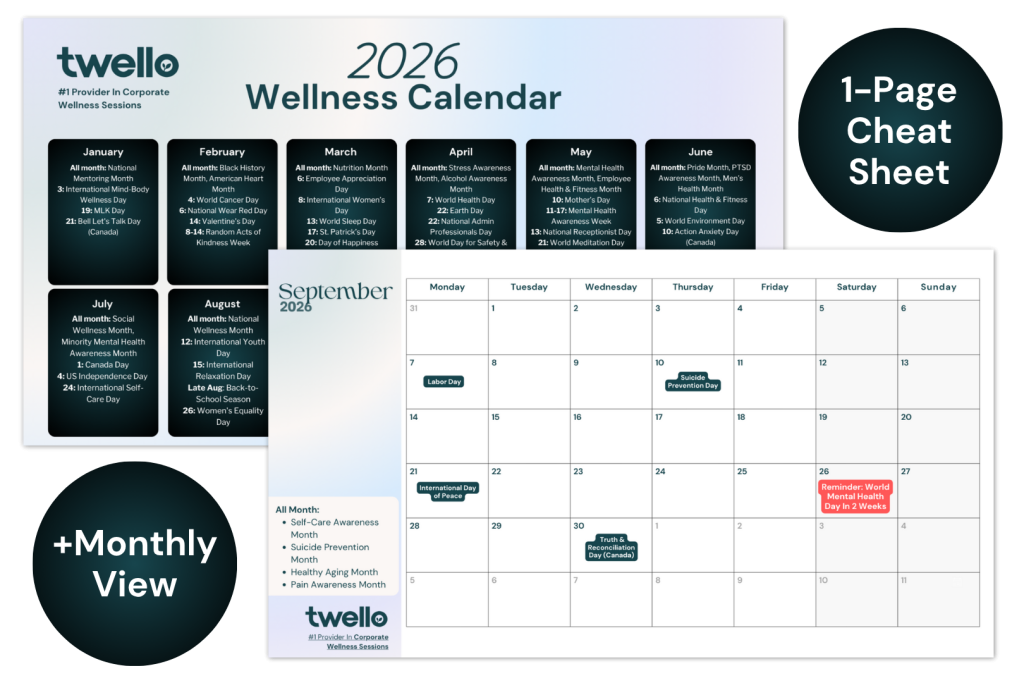
The PDF includes a 1-page cheat sheet and the full calendar with room for notes, so you can sketch ideas or flag dates for specific departments. Download here.

Author: Kayla Baum
Founder & CEO, Twello
Kayla Baum is the Founder & CEO of Twello, where she’s helped more than 1,200 organizations, including
KPMG, Amazon, Capital One, and CARE International bring practical, evidence-based wellness into the workday.
Working closely with HR and People & Culture teams every day gives her a grounded perspective on what
actually supports employee well-being (and what never gets used).
Each date on this awareness calendar is vetted through leading health agencies and long-standing
observance organizations, then filtered through Twello’s real-world experience of what workplaces can
realistically acknowledge. No noise. No gimmick days. Just what matters for teams.
Areas of Expertise
Bring Your Workplace Wellness Days To Life
We’re here to help you plan your workplace wellness programs.
Fill out the form, and we’ll send over pricing, class recommendations, and samples.